In an increasingly connected yet fragmented world, Europe is at a crossroads. As global digital platforms consolidate control over data, services, and markets, questions of autonomy, resilience, and inclusion are coming to the fore. To address these challenges, Europe must move beyond reactive regulation or isolated investments. It needs a fresh approach to digital infrastructure—one rooted in openness, interoperability, and public accountability.
This blog series explores why open network architectures—built on modular protocols and governed as digital commons—offer a strategic pathway for Europe.
- In Part 1 below, we examine how open networks can strengthen Europe’s digital sovereignty and competitiveness.
- Part 2 then explores how Europe can build its own coherent, interoperable digital stack to operationalize this vision.
Introduction
Europe is highly dependent on the US for its digital needs – across hardware, software and services – all of which are getting increasingly integrated into inseparable bundles. Europe recognizes that the position they find themselves in threatens its sovereignty, resilience and competitiveness given the global geopolitical environment we are in today. Europe must urgently unshackle itself from the US-dominated digital ecosystem in which it is increasingly entangled.
While the U.S. dominates with platform-centric innovation and China with state-led scale, India has demonstrated a powerful alternative: digital public infrastructure (DPI) and open networks built on interoperability, user-centric design, and inclusion. Europe can draw on this experience to advance its own goals — not by copying India’s model, but by adapting the underlying principles to its own context. In doing so, it can strengthen sovereignty, empower small businesses, and embed resilience into industry, supply chains, and governance.
In this context, open networks aren’t just a technical solution — they are a strategic infrastructure for sovereignty, sustainability, and fair competition.
Why Open Networks Matter for Europe
Europe’s digital priorities differ from those of India or the U.S. While India focuses on inclusion and leapfrogging access, and the U.S. thrives on platform dominance, Europe is centered on sovereignty, fairness, and sustainability.
| Factor | India Context | US Context | Europe Context |
|---|---|---|---|
| Digital Infrastructure | Government-led DPI (e.g., India Stack, ONDC) | Platform-centric ecosystems led by Big Tech | Market-driven but public-interest regulation (e.g., GDPR, DMA) |
| Tech Ecosystem | Building alternatives to Big Tech from scratch | Dominated by large, vertically integrated tech giants (Amazon, Google, Meta) | Highly regulated market, dominated by US platforms |
| Regulatory Posture | Pro-innovation + state stewardship | Historically lax regulation, increasing antitrust scrutiny recently | Federated, pro-privacy, competition-first, user protection |
| Geopolitical Concerns | Sovereignty + inclusion | Global tech leadership, export controls, and influence over digital norms | Balancing digital sovereignty with US/China dependency |
| Market Priorities | Affordability, digitization | Innovation-led growth, platform dominance, user engagement | Fair markets, resilience, sustainability, security, citizen rights |
India prioritizes inclusion; Europe prioritizes sovereignty. But both share a foundation of openness, interoperability, and public purpose. The difference lies in the strategic context, not the core values.
The Problem with Europe’s Current Digital Setup
Despite progressive regulation and an ambitious digital agenda, Europe’s digital infrastructure remains fragmented, dependent, and difficult to scale — limiting its ability to enforce policy, compete globally, and deliver on sovereignty, sustainability, and innovation goals.
1. Lack of Native Digital Platforms
Europe lacks large-scale, homegrown digital platforms comparable to Amazon, Google, Meta, or Alibaba. While smaller and niche platforms exist, their limited scale creates critical vulnerabilities:
- Digital sovereignty risks: Key data, algorithms, and infrastructure are controlled by non-European actors, creating structural legal vulnerabilities. U.S. laws such as the CLOUD Act and FISA allow American authorities to access data held by U.S. companies—even if stored in the EU. This compromises GDPR protections and weakens Europe’s ability to enforce its own standards on privacy, competition, and industrial policy.
- Gatekeeper bottlenecks: European businesses depend on centralized platforms for discoverability, payments, and user access—often governed by opaque algorithms and high fees. This creates structural asymmetry in market access.
- Innovation asymmetry: Dominant platforms lock in users and hoard data, leaving little room for local startups to compete. Platform-based data monopolies stall innovation and skew investment flows.
2. Fragmented Infrastructure
Europe’s digital infrastructure is not truly unified, despite the EU Single Market. In practice, the EU operates as multiple markets, and services that cross national borders face persistent barriers:
- Cross-border friction: Identity verification, digital payments, and compliance processes vary by country, hampering seamless access to EU-wide services.
- SME scalability issues: SMEs lack the interoperable tools and common onboarding layers to scale efficiently across the EU, limiting the benefits of the single market.
3. Weak Data Portability and Control
While the GDPR provides strong legal rights, they remain largely symbolic in the absence of usable infrastructure:
- Non-portable consent: Data cannot easily be transferred between platforms or services. Each platform has its own walled garden of consents and terms, making user control impractical.
- Lack of user tools: Individuals have no standardized dashboard to track, manage, or revoke data access across services in real time.
4. Siloed Green Compliance
The EU is raising the bar on environmental transparency and traceability—but lacks the infrastructure to support it:
- Fragmented ESG reporting: Data on carbon emissions, energy use, and circularity is scattered across incompatible systems, creating duplication, inefficiencies, and greenwashing risk.
- Compliance remains a burden rather than a capability: Reporting for regulations like the CSRD and EU Battery Regulation is often manual, costly, and difficult to verify across supply chains.
5. Limited Government Enforcement Capacity
Europe has bold regulations — but weak enforcement capacity at both national and EU levels:
- Infrastructure dependence: Enforcement relies on data and infrastructure often held by non-EU entities, which limits real-time oversight.
Europe already has the building blocks – Now it needs to connect them
Europe’s digital initiatives already reflect the core design values of open networks — interoperability, federation, data sovereignty, and user-centric control. What’s needed now is to connect and expand these efforts into a coherent, holistic ecosystem that can scale across sectors and borders.
| Domain | Initiative | Description |
|---|---|---|
| Manufacturing | Manufacturing-X (Germany) | Focuses on federated data sharing across industrial stakeholders to support Industry 4.0 |
| Automotive Supply | Catena-X | Enables real-time, standardized data exchange in automotive supply chains for sustainability |
| Cloud/Data Sovereignty | Gaia-X | Builds federated cloud infrastructure based on interoperability and transparency |
| Mobility | Mobility Data Space (Germany) | Focuses on data sharing infrastructure among mobility providers using open standards |
| Mobility-as-a-Service (MaaS) | Amsterdam, Zurich, Paris | City-level open mobility platforms that integrate public and private transport, independent of aggregators like Uber; promote fair competition and public-interest design |
| Logistics | FEDeRATED | Develops decentralized digital infrastructure for logistics and freight interoperability |
| Digital ID | eIDAS 2.0 + EU Wallet | Provides trusted, portable identity and credentialing for cross-border EU services |
Europe doesn’t need to invent open networks — it’s already experimenting with them across mobility, manufacturing, cloud, identity and other use cases. The opportunity now is to connect and scale these efforts into a unified, values-aligned digital ecosystem.
Managing Modern Risk through Open Network Framework
Open networks promote principles of competition, market accessibility, sovereignty, and resilience while also enhancing governance capacity — enabling governments to monitor, regulate, and enforce rules more effectively, particularly in data governance, competition oversight, and sustainability.
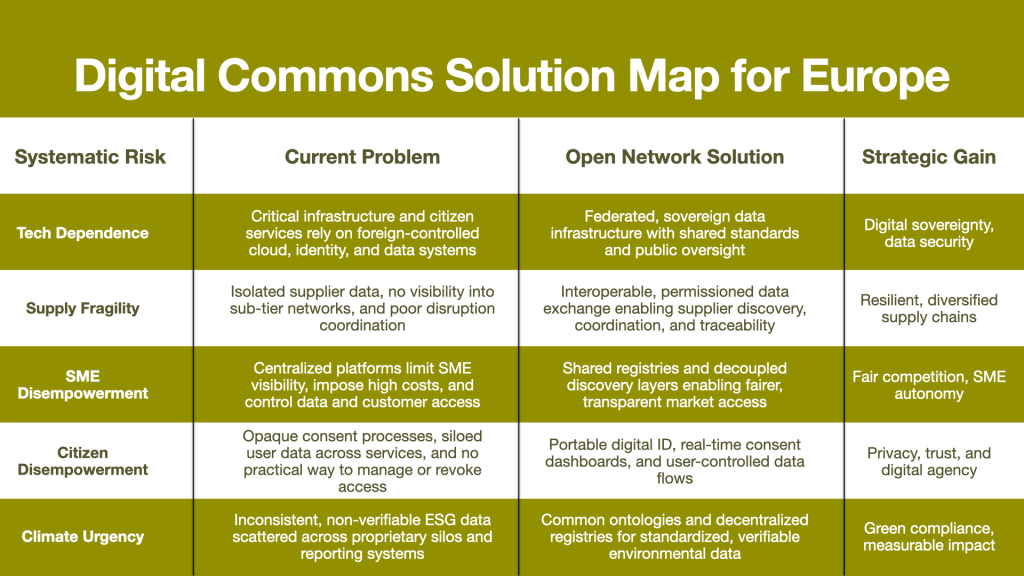
Here’s how open networks address five systemic risks:
1. Tech Dependence
Problem: US tech giants dominate Europe’s digital economy—not just through consumer-facing platforms, but by controlling critical infrastructure like cloud computing, identity systems, data hosting, etc. This creates systemic dependency, undermines Europe’s digital sovereignty, and limits its ability to enforce its own standards on privacy, competition, and industrial policy.
Solution: Open, federated frameworks establish interoperable and sovereign data infrastructure, where cloud and data services from different providers operate under shared European rules. Europe’s Gaia-X framework lays down standardized interfaces, identity protocols, and data governance models for trusted, cross-provider data sharing across sectors like health, mobility, and energy. Implemented consistently and backed by semantic standards, identity systems, and trust frameworks, Gaia-X has the credentials to create a decentralized, federated digital infrastructure—allowing Europe to move away from dependence on vertically integrated US tech giants and toward a plural, policy-aligned ecosystem.
Benefit: Europe regains control over its digital backbone through orchestrating platform independence and creating resilient sectoral digital ecosystems aligned with its democratic values and long-term strategic autonomy. It also restores its ability to implement and enforce laws that protect citizen privacy in practice—not just in principle.
2. Supply Fragility
Problem: Europe’s supply chains are vulnerable because its companies often lack visibility into their extended supplier networks—especially lower-tier suppliers who may be located in high-risk regions or operating under unknown conditions. Information is trapped in siloed, incompatible systems across firms, making it hard to share data about sourcing, inventory, or disruptions in real time.
Solution: Open network architecture enables interoperable, permissioned data exchange across supply chain participants—manufacturers, suppliers, logistics, financial, and other service providers. It supports supplier diversification by enabling the discovery of alternate suppliers across regions and tiers, and by reducing lock-in to single intermediaries. It also facilitates better coordination not just with direct suppliers, but with sub-tier vendors deeper in the value chain. Combined with verified compliance and real-time traceability, this enhances ecosystem-level visibility and resilience in the face of changing business dynamics, regulatory shifts, or geopolitical shocks.
Benefit: Open networks facilitate the creation of resilient, transparent, and agile supply chains that are less dependent on single suppliers or opaque foreign intermediaries. This improves strategic autonomy, strengthens crisis response, and supports European regulatory initiatives like CSRD and the EU Critical Raw Materials Act.
3. SME Disempowerment
Problem: Small and medium enterprises (SMEs) are disadvantaged in the current digital setup dominated by US hyperscalers. The platform algorithms of these companies prioritize high-volume sellers and well-known brands, making it difficult for SMEs to be discovered. At the same time, SMEs surrender control over pricing, customer data, and branding—while paying steep commissions or fees to participate in the digital ecosystem that is rigged against them.
Solution: Open network architecture democratizes market participation through shared discovery and transaction layers that decouple access from ownership. SMEs can be listed across multiple marketplaces and applications while maintaining control over their digital identity, pricing, and customer relationships. Federated registries, interoperable onboarding, and standardized interfaces reduce entry barriers and eliminate lock-in to any single platform. This shared infrastructure also enhances market transparency, improves discoverability, and mitigates the influence of gatekeeping algorithms that often favour dominant players.
Benefit: SMEs operating in an open networked ecosystem gain equitable access to digital markets, enabling competition based on innovation and service quality rather than platform affiliation. Open networks reinforce Europe’s competition policy goals while promoting a more diverse, innovative, and locally grounded digital economy.
4. Citizen Data Disempowerment
Problem: Although the GDPR grants individuals legal rights over their personal data, those rights remain difficult to exercise in practice. Consent is often buried in lengthy terms and conditions; users have little visibility or control over how their data is collected, shared, or monetized; and data portability is limited to cumbersome manual processes. As a result, individuals remain disempowered in a digital economy increasingly driven by personal data.
Solution: Open network architecture is inherently designed for user-centric data sharing. Its standard features include decentralized identity systems, standardized access layers, and consent-based data flows embedded into the digital public infrastructure. These systems, governed by trusted institutions and transparent oversight, allow individuals to control their data in real time—across sectors, services, and borders.
Benefit: Citizens gain meaningful, actionable control over their digital footprint. Data becomes a source of empowerment rather than extraction, restoring trust in the digital ecosystem and enabling safe, personalized, and privacy-respecting services in both public and private domains. Europe also recovers its ability to implement rights-based frameworks like the GDPR with real enforceability and citizen agency.
5. Climate Urgency
Problem: Efforts to meet Europe’s climate goals are constrained by fragmented, siloed data systems. Environmental, social, and governance (ESG) data—such as carbon emissions, material provenance, and product lifecycle impact—is scattered across proprietary platforms and supply chains. Without shared standards or interoperable systems, it is difficult for companies to measure Scope 3 emissions, track circularity metrics, or comply efficiently with sustainability regulations. This turns ESG into a compliance burden rather than a strategic advantage.
Solution: Open networks can provide a shared, interoperable foundation for environmental data exchange. Through standardized data formats, common ontologies, and decentralized registries, stakeholders across industries can share verified emissions data, trace material flows, and collaborate on sustainability targets—while retaining control over proprietary information. These systems turn ESG reporting from an isolated task into a networked capability.
Benefit: A robust open network that provides for the sharing of sustainability data can ease the tracking and reporting burden by providing access to relevant data. This makes sustainability goals actionable, measurable, and verifiable at scale. Open networks viewed in this way would allow Europe to substantially advance its climate commitments, support green innovation, and build transparent, circular value chains aligned with the European Green Deal and corporate sustainability mandates.
The European Case for Open Networks
Europe doesn’t need to reinvent its digital future — it needs to interconnect the building blocks already in motion. Across sectors and borders, Europe is piloting the core components of open networks: federated data spaces, digital identity frameworks, and trust-based infrastructure. What’s missing is a unifying vision that sees these not as isolated projects, but as the foundation of a next-generation digital commons.
Open networks offer Europe a unique opportunity to align sovereignty with interoperability, competition with fairness, and innovation with inclusion. They enable a digital ecosystem where no single actor dominates, where citizens and SMEs retain agency, and where sustainability becomes a shared capability.
 SANDEEP MAHAJAN
Leave a reply to EuroStack: Why Europe’s Digital Stack Needs a Commons Mindset – SANDEEP MAHAJAN Cancel reply