Lets say you run a small grocery shop in Bangalore. You’ve stocked Basmati rice, tea, and pulses. You’re thinking of selling online as you know that selling online can amplify your reach and maximize sales —but here’s the catch:
Setting up your own website is one thing. But how will customers find it? You’d have to spend time and money promoting your website, just to show up in someone’s search results. And how do you even compete with giants like Amazon or Blinkit?
Now imagine this: customers discover your store and its products without you doing any marketing—because your store is already part of a larger, open network that connects you to buyers across apps.
That’s exactly what ONDC (Open Network for Digital Commerce) enables: sign up once, and get discovered across buyers apps.
This blog walks you through how discovery works in open networks like ONDC. Using a small grocery store in Bangalore as an example, it explains how open protocols and interoperable apps help sellers get found—without needing their own websites or advertising budgets.
Seller Apps and Nodes
The ONDC network is like a web with many seller apps connected to it. Each seller app is a node on the network, helping sellers register their stores and upload product catalogs.
As a first step, you research different seller apps and choose one that suits your needs. Let’s say you pick a digital platform called StoreConnect (fictional), designed to help small businesses like yours go digital. It offers an easy sign-up process, helps upload your catalog, and makes your store “network-ready.”
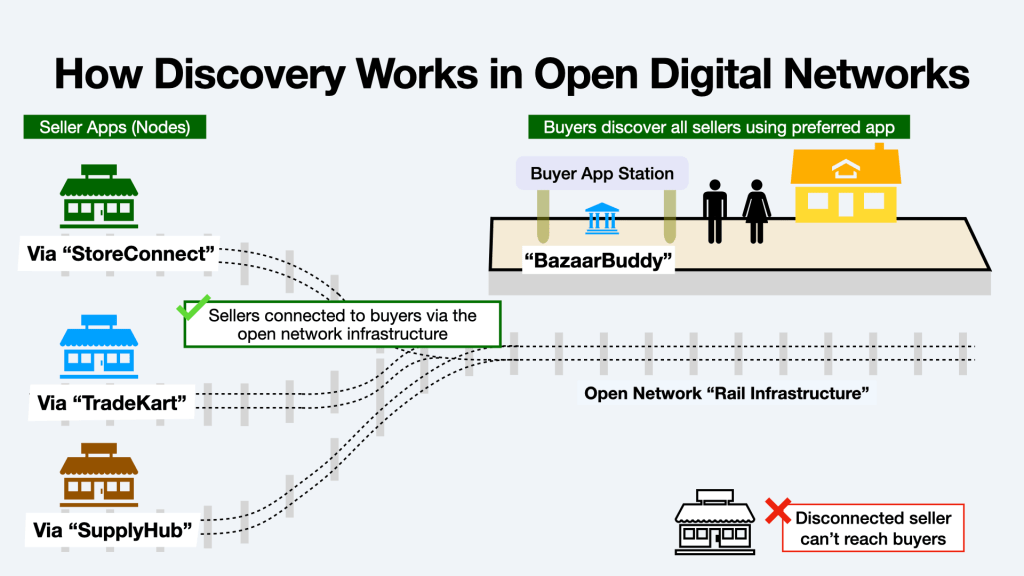
Once you’re on StoreConnect, your store automatically becomes part of the larger ONDC network and you can sell to buyers irrespective of which buyer node they originate at. This ability to connect and transact across nodes is called interoperability.
How Does a Node Work?
Apps like StoreConnect that onboard sellers are called seller nodes. They’re wired into the network’s digital infrastructure and speak a common language—the ONDC protocol.
Think of a seller node like a station on a national railway network.
When you register with StoreConnect, you’re not building your own private rail line—you’re opening a store at a well-connected station. The tracks (the ONDC protocol) are already laid, and trains (buyer queries) are running. Now, when someone searches for a product, there’s a ready-made path that brings their query right to your storefront.
The Role of the Registry
How does the network even know that StoreConnect exists?
That’s where the Registry comes in. The Registry is like a directory service for the network. It doesn’t host products or control apps—it just keeps track of who’s connected and what they do. When a buyer searches, the Gateway checks the Registry to see which apps might have what they need.
So when a buyer searches for “Basmati rice in Bangalore” using a buyer app like BazaarBuddy (also fictional), here’s what happens:
- BazaarBuddy sends a discovery request to the ONDC Gateway.
- The Gateway checks the Registry to find relevant seller nodes that can participate.
- It forwards the query to StoreConnect and other matching nodes.
- StoreConnect searches its sellers’ catalogs and returns relevant results—like your store’s Basmati rice listing.
- The buyer sees your product on BazaarBuddy, even though they’ve never heard of your store.
The Result
Interoperability in Action
Here’s the magic: you and the buyer aren’t using the same app, but you can still find each other and transact. That’s interoperability.
And it’s not new. If you’ve ever used email, you’ve experienced interoperability. You might use Gmail, your friend might use Outlook—but you can still send and receive emails seamlessly.
In the same way, open networks allow for discovery, transactions, and fulfillment across apps.
Why This Works
A Decentralized Network of Nodes
The real power of open networks lies in decentralization:
- There are many seller apps—you choose the one that fits your needs.
- There are also many buyer apps—customers can use whichever one they like.
- The registry doesn’t control or own anyone—it just helps connect the dots.
This creates a flexible, inclusive system where new apps can plug in, and existing ones can interoperate without silos.
Closing Thought
You’re Not Just Online, You’re On the Network
By joining a seller app that acts as a node on an open network like ONDC, your local grocery store becomes part of a national—or someday even global—commerce ecosystem. And you didn’t have to build the infrastructure yourself.
In today’s digital economy, being online isn’t enough. Being discoverable is what matters.
Note: This blog uses fictional examples (like StoreConnect and BazaarBuddy) to explain how real open networks function. In practice, ONDC in India is already making this model a reality— across sectors from retail and mobility to education and financial services.
 SANDEEP MAHAJAN
Leave a comment