This post builds on Part 1 of our series on Europe’s digital future, where we explored why open networks are essential to digital sovereignty, resilience, and fair markets. In this follow-up we examine how Europe’s current digital infrastructure measures up—and what it would take to transform it into a coherent, commons-governed system.
In recent years, “digital sovereignty” has moved from Brussels white papers into mainstream discourse. At its core lies a growing focus on digital public infrastructure (DPI)—now a strategic buzzword across Europe. From eIDAS 2.0 to sectoral data spaces and cloud sovereignty initiatives, we’ve seen a wave of public and private efforts aiming to shape a more open, interoperable, and resilient digital future.
In this context, a conceptual blueprint for Europe’s digital future has been championed by organizations like Open Future, Next Generation Internet, and the Eurostack.info coalition—each advocating for digital infrastructure rooted in European values and grounded in European imperatives. Like India Stack, it imagines a layered, interoperable infrastructure spanning identity, data, compute, and services.
What Is EuroStack?
EuroStack is not a single EU program; it’s a digital ecosystem “made, governed, and operated in Europe.” Anchored in industrial policy, it is a strategic and policy advocacy vision which proposes a layer-by-layer model combining:
- Semiconductors and edge compute
- Sovereign cloud and AI capacity
- Cybersecurity, digital identity, and data spaces
- Open standards and public-service infrastructure
- Public procurement reform (“Buy European”)
- Sovereign fund to finance digital ecosystem initiatives
In this blog, we focus specifically on the digital public infrastructure (DPI) aspects of EuroStack, setting aside adjacent enablers such as:
- Investments in chips and cloud: strategic but not DPI in themselves
- Procurement mandates: economic instruments, not infrastructure
- The Sovereign Tech Fund: a financing mechanism, not part of the stack
We also explore how these DPI ambitions can move from blueprint to implementation, and how Europe can build on what already exists.
What Does Europe’s Stack Look Like Today
Europe has assembled many of the core building blocks of digital public infrastructure. Across key layers, it has created meaningful assets. But having the parts is not the same as having a connected system. The opportunity now is to integrate, scale, and govern them more effectively.
- Digital Identity: The revised eIDAS 2.0 regulation mandates that every EU Member State offer a cross-border-recognized digital identity. The upcoming EU Digital Identity Wallet will enable citizens and residents to access both public and private services throughout the Union.
- Payments: The TIPS system (TARGET Instant Payment Settlement) enables real-time euro transfers across Europe. The Payment Services Directive (PSD2/3) mandates open banking APIs to foster a competitive, integrated payments ecosystem.
- Data Interoperability: Regulations like the GDPR and the Data Act create frameworks for portability and reuse of personal and non-personal data. The Single Digital Gateway Regulation mandates access to online administrative services across borders. Semantic standards, APIs, and trusted data intermediaries are also supported through EU-funded initiatives.
- Trust Services: Under the eIDAS framework, qualified trust services (e.g., digital signatures, timestamps, and seals) are legally recognized across borders. These form the backbone for secure, verifiable digital transactions at scale.
- Application Layer: Europe has developed and piloted federated data spaces and shared semantic standards across domains like healthcare, mobility, and public administration. The goal is to make digital services interoperable by design—reducing duplication, enabling data reuse, and allowing Member States to build on common components rather than starting from scratch.
Green Shoots: Where EuroStack Is Already Taking Root
- Ségur numérique (France): Accelerating adoption of interoperable eHealth services
- European Blockchain Services Infrastructure (EBSI): Trust-based credential exchange
- Mobility-as-a-Service (Amsterdam, Zurich): Federated platforms connecting transport providers
How does it compare to India’s DPI
While Europe has many foundational pieces, India has demonstrated how these can be unified into a coherent stack. Below is a comparison of the two approaches across key layers of digital public infrastructure:
| DPI Layer | Europe | India |
|---|---|---|
| Digital Identity | eIDAS 2.0 mandates cross-border digital IDs; EU Digital Identity Wallet enables citizens to access services across Member States. | Aadhaar + DigiLocker offer universal digital ID and document storage; usage is widespread, though more centralized. |
| 🟰 Opt-in, privacy-preserving by design. | 🟰 Mandatory for many services, but designed for scale and integration. | |
| Payments | TIPS offers instant euro settlement; PSD2/3 mandates open banking APIs and nudges adoption via regulatory incentives. | Unified Payments Interface (UPI) is a centrally orchestrated real-time payment system with massive adoption and open access. |
| 🟰 Infrastructure-led approach; adoption is encouraged, not mandated. | 🟰 Government and NPCI actively drove integration and scale-up. | |
| Data Interoperability | GDPR, the Data Act, and the Digital Gateway promote data portability, semantic standards, and trusted intermediaries. | Account Aggregator (AA) + ULIP connectors create interoperable data-sharing rails across sectors. |
| 🟰 Federated and privacy-first, but fragmented. | 🟰 Centrally supported frameworks enable easier service-layer integration. | |
| Trust Services | eIDAS framework supports eSignatures, timestamps, and seals; qualified trust services are cross-border recognized and legally enforceable. | DigiLocker enables digital signing and verification of documents, with limited legal embedding compared to EU’s approach. |
| 🟰 Legal trust deeply integrated across Member States. | 🟰 Operational trust tools, but legal mandates are narrower. | |
| Application Layer | Your Europe portal, eProcurement, and CEF Building Blocks support cross-border service delivery and reduce duplication for Member States. | Shared platforms and APIs under Digital India enable rapid digitization (e.g., GEM, UMANG, eDistrict services). |
| 🟰 Strong standards but slow coordination across countries. | 🟰 Faster deployment due to centralized leadership and implementation pathways. |
From Blueprint to System: What Europe Needs Now
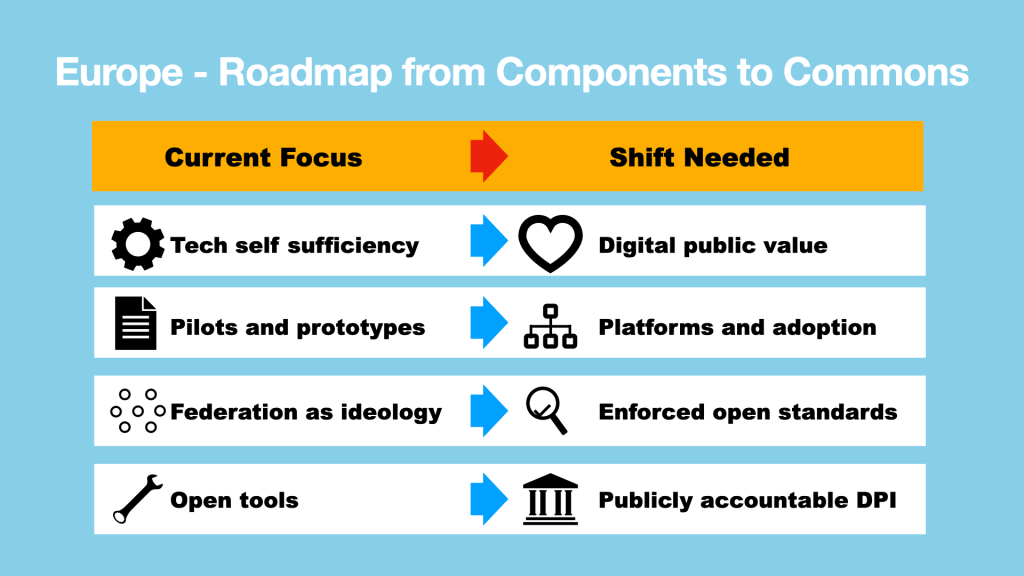
Despite strong individual efforts, Europe lacks a truly integrated digital public infrastructure (DPI). Crucially, the challenge isn’t about missing components—it’s about fragmented vision, weak mandates, and lack of systemic coordination. Europe has rich building blocks: digital identity, trusted services, semantic APIs, and sectoral data spaces. But without shared rules, enforced standards, and public governance, they remain disconnected parts rather than an integrated whole.
Each of these structural gaps, however, reveals a powerful opportunity for coordinated action:
1. Missing Frame: DPI as a Commons → Opportunity: Public Digital Infrastructure
Before solving for components or standards, Europe needs a shared frame: that DPI is a public good. Without this, initiatives risk being driven by technical vendors or industrial interests—rather than serving people, public purpose, and long-term resilience.
What to do:
- Recast DPI as part of Europe’s essential public infrastructure, on par with roads or utilities.
- Embed commons-first principles into the legal, architectural, and institutional design of EuroStack
- Connect the dots across digital identity, data spaces, and services through public mandates, funding, and long-term stewardship
2. Federation Without Governance → Opportunity: Shared Rules and Stewardship
- Europe embraces federation—but often without a single market mindset. Lack of common rules or coordination leads to duplication, inconsistencies and uneven onboarding experiences across geographies and sectors.
What to do:
- Develop protocols for onboarding, credentials, and trust across layers and geographies.
- Encourage multi-stakeholder coordination forums (regulators, civil society, technical bodies) to align governance across domains.
- Position public institutions as stewards, not just funders—ensuring accountable, transparent DPI governance
- Connect the dots across digital identity, data spaces, and services through public mandates, funding, and long-term stewardship
3. Open Protocols Without Enforcement → Opportunity: Incentivized Openness
Open standards exist—but adoption is patchy and voluntary. Without mandates, vendors often default to proprietary systems, and openness remains a moral preference, not a strategic requirement.
What to do:
- Link public funding and procurement to open-standard adoption and maintainability.
- Provide technical and financial support for vendors to transition from proprietary to open-source solutions.
4. Too Many Pilots → Opportunity: Platformization
Europe leads in innovation, but lacks the institutional pathways to scale. Dozens of pilots (like Catena-X or Mobility Data Spaces) demonstrate potential—but have not mature into shared platforms or reusable infrastructure.
What to do:
- Scale successful pilots into production-grade DPI with long-term funding and roadmaps
- Support Member States and industries with implementation blueprints and sandboxes to test integration at scale.
5. Private Governance → Opportunity: Inclusive Stewardship
Working groups are often dominated by hyperscalers or technical elites. This sidelines civil society, SMEs, and municipalities—weakening trust and limiting relevance.
What to do:
- Ensure meaningful roles for SMEs, cities, and public-interest organizations in standards-setting and implementation
The Stack is not the System
If DPI is the digital equivalent of roads, then:
- Europe has the pavement materials (tools),
- A few village roads (pilots),
- But no blueprints, governance, or national rollout plans to connect the network.
Europe doesn’t need to start over. It needs to connect what it already has, scale what works, and govern it as a commons. That’s where the real opportunity lies.
 SANDEEP MAHAJAN
Leave a comment