Seeding a More Inclusive Digital Future
A quiet revolution is underway.
Across continents and sectors, a new model for digital infrastructure is beginning to take root. It’s not driven by mega platforms or proprietary ecosystems, but by open networks — decentralized, interoperable systems built on the principles of inclusion, transparency, and participation.
These early efforts are not without their challenges. But they represent a powerful shift in thinking: from building walled gardens to cultivating open commons. From locking value into monopolies to distributing opportunity through shared protocols. From extractive systems to empowering infrastructures that anyone can plug into.
These are the green shoots of a new kind of digital economy — one where growth is not just scalable, but equitable.
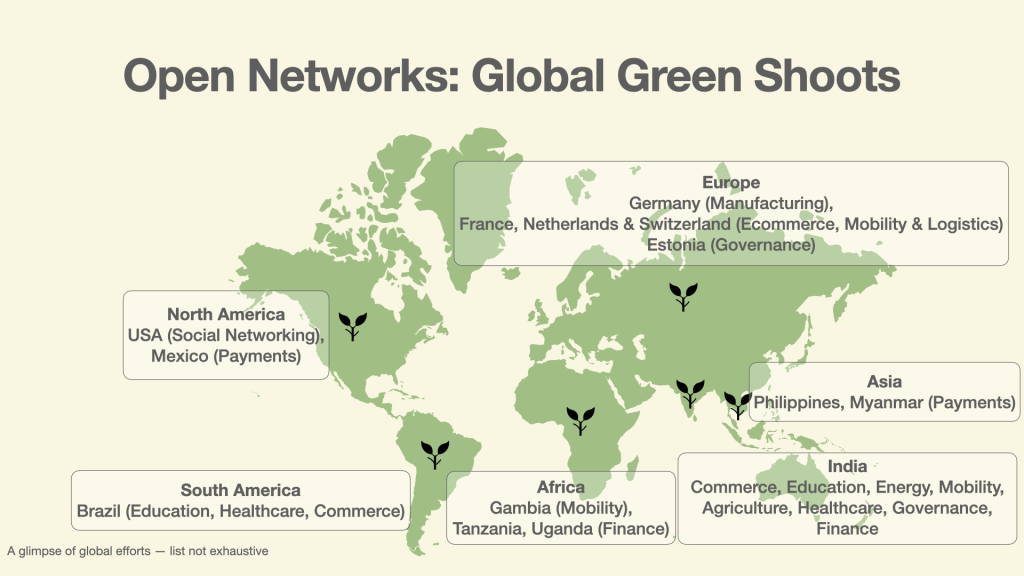
India: The Global Testbed for DPI Innovation
India is, without doubt, the world’s most active laboratory for Digital Public Infrastructure (DPI) and open networks.
- ONDC (Open Network for Digital Commerce) is attempting to unbundle e-commerce from dominant platforms, giving local sellers, small retailers, and new-age apps a shared infrastructure to transact across domains.
- ONEST (Open Network for Education and Skilling Transactions) is opening up access to learning resources, training programs, and skilling opportunities on a common interoperable backbone.
- UEI (Unified Energy Interface) enables interoperability across EV charging providers in India. It allows users to discover, book, and pay for charging services through any compatible app, offering a seamless and unified experience regardless of the service provider.
- Namma Yatri and the Kochi Open Mobility Network are early but successful experiments in open mobility — giving commuters choice and auto drivers direct access to digital demand without intermediaries.
These efforts are more than pilots — they are working proofs that open networks can deliver real-world value.
In addition to the above, India is developing open networks across several other critical sectors.
- In agriculture, the proposed Agristack initiative aims to create an open data and service network to support farmers with personalized advisories, credit access, and market linkages.
- In healthcare, the National Digital Health Ecosystem (NDHE) envisions an open, interoperable health network connecting hospitals, insurers, labs, and citizens through digital health IDs and consent-based data sharing.
- In urban governance, the DIGIT platform provides cities with open-source tools for service delivery and citizen engagement.
- The Open Credit Enablement Network (OCEN) is building standardized protocols to connect lenders, marketplaces, and borrowers — unlocking access to credit for small businesses and informal workers.
All of these efforts point toward a future where India’s digital infrastructure is not just public, but open by design.
Brazil: A Forest Region Leads the Way
In the Amazon region of Brazil, the Rede Belém Alberta initiative is reimagining local economies through open networks. Focused on education, healthcare, and sustainable commerce, this effort connects local producers to markets while promoting community-led innovation.
It’s a powerful reminder that digital transformation need not be top-down — it can start in the forest, not just the capital.
Africa: Open Networks for Local Entrepreneurship
Across Africa, open infrastructure is being used to unlock opportunity in high-friction sectors:
- Open Gambia, a nationwide initiative led by the Foundation for Digital Economy in partnership with the Government of The Gambia, aims to establish an open transaction network for digital commerce inspired by India’s open network model. The initiative will launch first with a focus on skilling and is set to expand into critical sectors such as urban mobility, agriculture, health, and tourism—laying the groundwork for an inclusive, knowledge- and innovation-driven economy.
- Mojaloop, originally developed by the Gates Foundation, is an open-source software platform that enables real-time, interoperable payment systems to drive financial inclusion. It is designed for national-scale adoption and is currently being implemented in countries such as Mexico, Myanmar, the Philippines, Rwanda, and Tanzania to build inclusive, interoperable digital finance infrastructure.
Europe: Interoperability Meets Industrial Strategy
Europe is advancing open networks across multiple strategic sectors, integrating cutting-edge technologies in high-tech manufacturing, smart mobility and urban infrastructure.
- Germany’s Manufacturing-X initiative is building a federated data ecosystem for Industry 4.0. It enables companies to share excess inventory, manufacturing capacity, and logistics infrastructure — improving resilience and sustainability.) initiative is building a federated, open data ecosystem for Industry 4.0 that enables companies to share data and collaborate across supply chains while retaining digital sovereignty. It empowers businesses to increase process efficiency through standardized data exchange, co-innovate with partners, develop new data-driven models like manufacturing-as-a-service, and optimize value networks with solutions for demand and capacity management and energy load balancing. By fostering cross-sector collaboration, it aims to boost resilience, sustainability, and competitiveness through interoperable, data-driven innovation.
- Frances Padam Mobility, in collaboration with Île-de-France Mobilités, is developing a unified, demand-responsive public transport system that spans over 40 territories in the Greater Paris region. Built on open data standards and shared digital infrastructure, the system enables seamless booking, real-time tracking, and integration with other public transport services — demonstrating how mobility networks can be inclusive, interoperable, and locally adaptable.
- Amsterdam has initiated a pilot called the Open Amsterdam Network, enabling hyperlocal commerce and delivery, by deploying Beckn-compatible APIs that allow local businesses and couriers to connect over a shared, interoperable infrastructure
- Zurich is exploring Beckn-style integration in its urban transport systems, aiming to create a unified, app-neutral service for ticketing and logistics through standardized, open API design that mirrors Beckn’s open-network model.
Estonia: Digital Governance Through Open Infrastructure
Often cited as the poster child of e-governance, Estonia’s X-Road is an open-source data exchange layer that allows public and private sector organizations to securely share data. It’s a reminder that openness can coexist with strong security and trust, even in sensitive sectors like governance and health.
**The United States: Reimagining Social Protocol
While the internet’s core infrastructure remains open, much of today’s digital experience is shaped by centralized platforms that control user data and identities. Initiatives like Protocol Labs, Bluesky, and Farcaster are developing decentralized protocols for social networking that aim to restore user control, enable data portability, and foster interoperability — challenging centralized gatekeepers and advancing a more user-empowered digital future.
- Protocol Labs is building open, protocol-based decentralized infrastructure through projects like IPFS, a peer-to-peer, content-addressable file system. It enables anyone to store and retrieve data from a distributed network of nodes, rather than relying on centralized servers.
- Bluesky is developing the AT Protocol, an open and decentralized social networking protocol that allows users to move their identity and content between apps. By separating the application layer from data ownership, Bluesky aims to create a federated, user-centric ecosystem that reduces reliance on centralized platforms.
- Farcaster is a decentralized social protocol that allows developers to build interoperable apps where users retain control over their data and identity. It uses an open registry and identity system to enable app-neutral communication while preserving user autonomy across services.
From Green Shoots to Global Canopy
These examples, scattered as they may seem, are not isolated experiments. They represent the early shoots of a new digital architecture — one that is open by design, collaborative by nature, and inclusive in intent.
What happens when these ideas and efforts start to cross-pollinate — when India’s open logistics solutions inspire Germany’s manufacturing innovations, or when infrastructure layer innovations in the US connect with data-sharing protocols from Europe? We could witness an explosion of innovation, led not by Big Tech, but by communities, startups, public institutions, and local entrepreneurs.
This is where inclusive growth can thrive — not as an afterthought, but as a default design principle.
Conclusion: A Digital Future for All
The promise of open networks is not that they will solve every problem. It’s that they shift the starting point. They
- invite more actors to the table.
- lower the barriers to entry.
- embed trust, interoperability, and equity into the infrastructure itself.
 SANDEEP MAHAJAN
Leave a comment