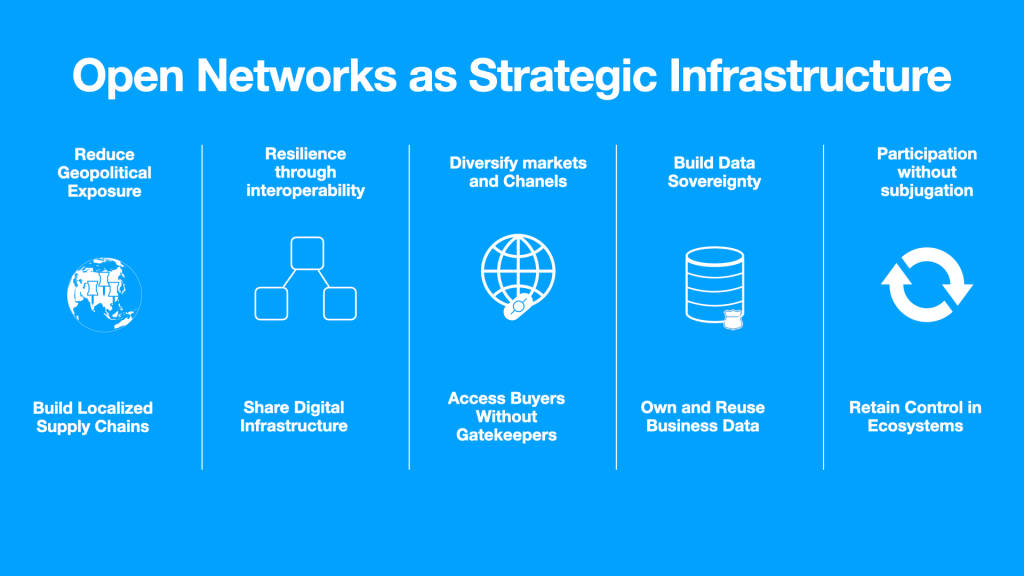
We often speak of open networks as the future of digital transformation. But that framing may no longer be enough. Today, they must be understood as something more urgent: infrastructure for survival, resilience, and sovereignty in a world that is anything but stable.
We are in a moment defined not by disruption, but by dislocation — a systemic rewiring of the geopolitical and economic order.
The Global Context: 2024–2025
We are witnessing a convergence of global shocks that are undermining the assumptions of global integration:
| Factor | Examples | Impact |
|---|---|---|
| Wars and Conflicts | Russia-Ukraine, Palestine-Israel, USA-Israel-Iran | Disrupted energy flows, global food supply, trade routes |
| Tariffs and Trade Wars | US-China-EU protectionism, digital tax disputes | Retrenchment of globalization, export/import volatility |
| Resource Control | China’s rare earths and battery dominance | Strategic bottlenecks, reshoring, national stockpiling |
| Fragmentation of Globalization | “Friendshoring,” “China+1” strategies | Rise of regionalism, fragmented value chains |
| Technological Sovereignty Push | National DPI, AI, chip and cloud infra | Vendor lock-in risk, digital fragmentation |
In this context, businesses face multi-front risks:
- fragile supply chains
- exposure to political shocks
- over-dependence on dominant platforms
- increasing digital monopolization
In this geopolitical environment, open networks become strategic infrastructure. Rather than being “just” tools for digital inclusion or market innovation, open networks emerge as a resilience architecture — one designed to handle volatility, fragmentation, and the growing unpredictability of our time.
Five Strategic Ways Open Networks Reduce Risk
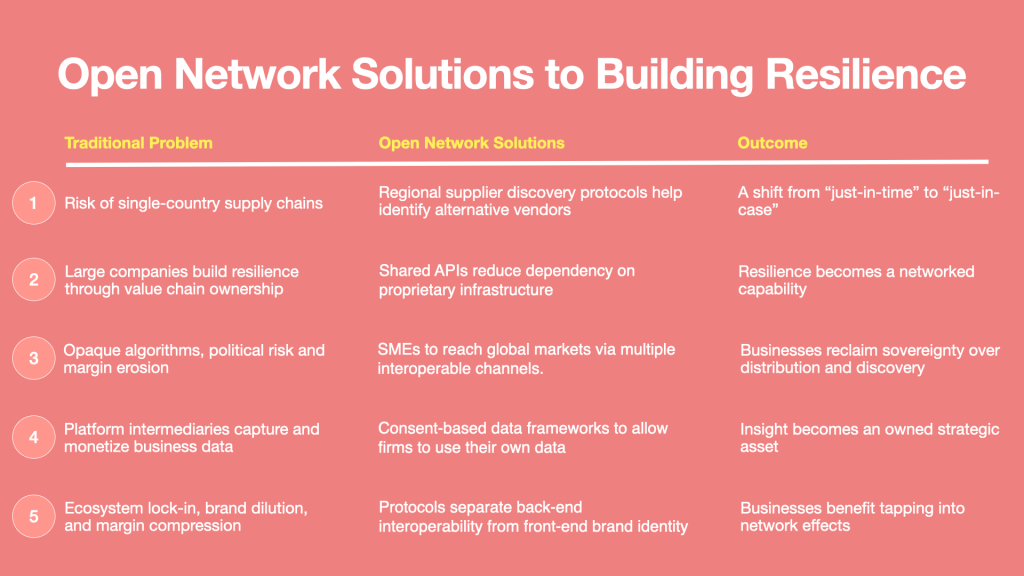
1. Reduce Geopolitical Exposure through Localized Supply Ecosystems
Problem: Businesses relying on single-country suppliers are vulnerable to shocks — e.g., rare earths from China or grains from Ukraine.
Open Network Solution:
- Regional supplier discovery protocols help identify alternative vendors across borders.
- Open logistics layers (e.g., modelled after India’s United Logistics Interface Platform [ULIP] stack) enable dynamic re-routing when conflict or climate disrupts routes.
Outcome: A shift from “just-in-time” to “just-in-case.” Open, federated B2B platforms build agility and redundancy without lock-in.
2. Resilience Through Interoperability, Not Vertical Integration
Problem: Companies like Amazon or Tesla build resilience by owning more of the value chain. But this is capital intensive and unscalable.
Open Network Solution:
- Shared APIs for logistics, payments, identity, and warehousing reduce dependency on proprietary infrastructure.
- Small and mid-sized enterprises (SMEs) can remain agile by plugging into digital infrastructure without building it all.
Outcome: Resilience becomes a networked capability — not a monopolized asset.
3. Diversify Markets and Channels without Gatekeepers
Problem: Exporters and producers using global aggregators (Amazon, Alibaba) face opaque algorithms, political risk, and margin erosion.
Open Network Solution:
- ONDC/Beckn-style discovery protocols allow SMEs to reach global markets via multiple interoperable channels.
- Governments and trade bodies can deploy local apps on open protocols to facilitate inclusive trade.
Outcome: Businesses reclaim sovereignty over distribution and discovery, rather than being disintermediated.
4. Build Data Sovereignty and Intelligence In-House
Problem: Platform intermediaries capture and monetize business data — from customers to pricing to logistics.
Open Network Solution:
- Consent-based data frameworks (like India’s Data Empowerment and Protection Architecture [DEPA]) allow firms to reuse and analyze their own transaction and customer data.
- Open data-sharing protocols encourage collaborative intelligence-building across the supply chain.
Outcome: Insight becomes an owned strategic asset, not a rented outcome.
5. Participate in Ecosystems Without Being Captured
Problem: Most digital ecosystems operate on a “winner takes all” logic — with lock-in, brand dilution, and margin compression.
Open Network Solution:
- Protocols separate back-end interoperability from front-end brand identity.
- A logistics firm, a school, or a health provider can interoperate without losing its interface, brand, or business model.
Outcome: Businesses benefit from scale without surrender, tapping into network effects without monopoly effects.
What Innovation Looks Like in This Model?
| Innovation Strategy | Solution | Examples |
|---|---|---|
| Resilient Sourcing Hubs | Open vendor discovery and substitution networks | Electronics manufacturers sourcing regionally via a Beckn registry |
| Distributed Fulfillment | Mesh-like logistics via ONDC-style infrastructure | Dynamic warehouse-routing based on demand and conflict risk |
| Cross-Border Trade Networks | Open DPI for regional corridors (e.g., Africa, SAARC) | Seamless trade via open data protocols and customs APIs |
| Circular Economy Models | Track-and-trace across fragmented supply chains | EV battery reuse, textile recycling using traceability protocols |
| Embedded Finance & Insurance | Contextual, micro-targeted financial services | Open fintech APIs for farmer credit, gig worker insurance |
From Fragility to Anti-Fragility
The defining feature of open networks isn’t just inclusion or competition. It’s adaptability.
As systems strain under geopolitical and environmental pressure, we need digital infrastructure that’s modular, federated, and reversible — capable of evolving without collapsing.
Open networks offer exactly that.
They help us build digital economies that are:
- Connected, but not dependent
- Cooperative, but not captured
- Global, but still governed
In an age of fragmentation, open protocols may be the most important infrastructure we build.
 SANDEEP MAHAJAN
Leave a comment